

Photovoltaic equipment
Understand why and how to import:
High electricity tariffs, which have been on the rise since 2015 (and have already increased by around 48% by 2023), have contributed to the rapid expansion of energy obtained from solar panels, whether for industrial, commercial or residential use. In addition, the taxation of solar energy, which came into force this year through Law No. 14,300 of 2022 (Legal Framework for Own Generation), and which determines the staggered payment of the Distribution System Use Tariff until 2029, has become another motivator for new consumers to opt for solar energy.
Want to learn more about solar energy, the opportunities the market offers and how to import solar panels? Check out this article. Happy reading!
Solar panels and their growth in Brazil:
The use of solar energy began in Brazil in 2012, due to Normative Resolution 482, and today it represents the second largest source in the country, behind hydroelectric power.
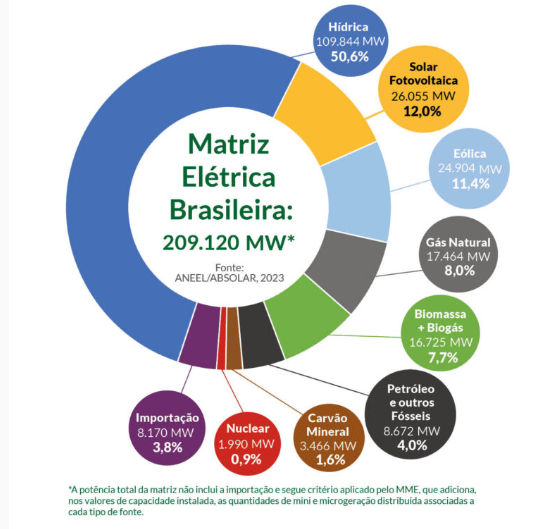
According to data released in March 2023 by the National Electric Energy Agency (Aneel) and the Brazilian Photovoltaic Solar Energy Association (Absolar), Brazil has 209,120 MW of installed capacity, of which 109,844 MW comes from hydroelectric power (equivalent to 50.6%), 26,055 MW from photovoltaic solar energy (12%), 24,904 MW from wind power (11.4%), and the rest from other energy sources, as shown in the graph below.
According to Absolar, as recently as January of this year, different municipalities in 16 Brazilian states achieved new solar energy capacity through distributed generation (DG) – which can be installed on residential, commercial, industrial and public building roofs.
By the end of the year, the association predicts a 42% growth in Brazilian solar energy capacity, as well as investments that could exceed 50 billion reais, and around 300,000 new jobs.
According to Absolar, the growth of solar energy in 2023 should be driven mainly by increases in electricity bills, added to other attractive factors. The projections made consider a conservative scenario, taking into account macroeconomic factors, the effects of energy policies, the possible modernization of the electricity sector, among others.
Advantages of using solar panels as an energy source:
There are many advantages to using energy generated by solar panels. The main one is savings, which can reduce electricity bill costs by up to 95%, since the sun is a free and inexhaustible resource.
It is also economical because it protects consumers from price increases from the distributor, thus allowing a quick return on the investment made in its acquisition. They have a long service life, with each module lasting at least 25 years. Maintenance is minimal, making the cost of maintaining solar panels low.
There are also important advantages for the environment, given that the energy obtained from solar panels is clean and highly sustainable, i.e. it does not emit pollutants or use up scarce natural resources, and is a renewable energy source.
Another benefit is that its operation (unlike wind power) is completely silent, helping to reduce noise pollution. And even the disposal of solar panels is sustainable, as they can be recycled with an efficiency of around 90%.
Access to solar energy, even in remote places where electricity is not distributed, is another advantage. Off-grid systems, which use batteries to store the energy captured by the solar panels, can conserve energy even on rainy days and at night.
Why import solar panels:
Currently, the manufacture of solar panels in Brazil is limited, so purchasing from countries where there is high production is an effective alternative to significantly reduce the investment cost.
Read also: Everything You Need to Know About Imports
In addition, thanks to Brazil’s climatic characteristics and the fact that it is one of the countries with the greatest potential for generating solar energy, the use of this energy source is favorable.
Incentives and tax benefits for importing solar panels:
In order to encourage the spread of solar energy in Brazil, various tax benefits are offered for the import of solar panels, as well as more than 70 lines of financing and financial guarantees for the acquisition of technology for their production and storage.
With the TIPI (Table of Incidence of Tax on Industrialized Products), the rate of IPI and ICMS on the import of solar panels is 0%.
As far as II is concerned, since there is no equivalent domestic production of photovoltaic equipment, it is possible to obtain a temporary reduction in the rate through the Ex-Tariff regime.
There is also REIDI, a tax regime that temporarily suspends the levying of PIS and COFINS on distributed mining projects (with a capacity of between 75kW and 5MW).
Read also: Import Tax Planning: 5 Important Points
How to import solar panels:
As with the import of other products, in order to import photovoltaic equipment, your company must be registered with RADAR Siscomex.
Once this is done, you must choose the type of product (panels/boards and/or inverters) to be imported and its respective supplier. Solar panels are imported with their components separated and assembled in Portugal.
When choosing a product supplier, it must be ensured that it meets INMETRO requirements. Today, China is home to the world’s largest solar manufacturers, both in terms of price and quality. Other countries with competitive options are South Korea, Canada and Germany.
When moving on to the international transportation stage (which in the case of solar panels is usually done by sea), attention must be paid to the amount of photovoltaic equipment arranged per container, which will vary according to the power of the panels and the type of inverters.
These and other stages of importing photovoltaic equipment require expertise in the process. With Superiaa specialist in the import of solar panels, your company can count on all the know-how that provides the necessary security for your import.
As well as working with INMETRO-certified suppliers, Superia has the benefit of a reduction in the ICMS rate of up to 14% when importing solar inverters. It also has reliable freight forwarders and customs agents.
Talk to our team right now and start profiting from the solar energy sector.